A church painting project is not like a commercial painting project. The budget approval process involves more decision-makers. The scheduling constraints are real and non-negotiable. The spaces being painted carry meaning to the people who use them that goes beyond their function as rooms. And the typical church facilities budget operates under constraints that most commercial property managers never face.
This guide is written for the facilities committee member, the deacon assigned to building maintenance, the pastor who got handed the painting project responsibility, and anyone else in a church or religious organization who is trying to figure out how to get a building painted properly without going over budget, disrupting services, or damaging anything that matters to the congregation.
Understanding How Church Painting Projects Actually Get Approved
In most commercial settings, a property manager can approve a painting project up to a certain dollar threshold and simply schedule the work. In most churches, the process involves a facilities committee assessment, a budget committee review, a board of elders or deacon board vote, and sometimes a full congregation announcement. This is not bureaucracy for its own sake. It is governance appropriate to an organization that is stewardship-accountable to its membership.
The practical implication for anyone managing a church painting project is that the timeline from idea to start date is almost always longer than expected, and the documentation required at each stage of the approval process needs to be more thorough than a single contractor quote.
What a church building committee needs in order to approve a painting project: a written scope of work that identifies each space to be painted, the surface conditions, any repairs needed before painting, the products specified and why, the project timeline, and the total cost broken into phases if the full scope exceeds a single budget cycle. The presentation also benefits from a clear explanation of why the project is needed now rather than deferred: deteriorating paint is not just an aesthetic problem but a maintenance liability that compounds if left unaddressed.
Working with a painting contractor who understands this process and can provide a proposal document suitable for board presentation is genuinely valuable. A quote on a piece of paper is not the same as a proposal that a board can vote on confidently.
Phasing Church Painting Projects Across Budget Cycles
Most churches do not have the available budget to paint the entire facility in a single year. This is not a problem. It is a planning parameter. Professional painting contractors with church experience know how to phase a project so that the highest-priority spaces are addressed in the first budget cycle and subsequent spaces follow in years two and three.
A common phasing structure for a medium-sized church facility: Year one, the sanctuary and lobby, which are the highest-visibility spaces that directly affect the congregation’s experience and the impression made on visitors. Year two, the fellowship hall and kitchen area, which tend to show wear faster than offices and classrooms due to heavy use. Year three, classrooms and offices, which are lower priority in terms of visibility but which still need to be maintained for the condition of the building overall.
Exterior painting follows a separate phasing logic. The exterior is a single unified appearance, which makes partial painting less aesthetically viable than interior phasing. When the exterior is due for painting, it should generally be done in its entirety rather than one elevation at a time, unless budget constraints are severe enough to require it.
Sanctuary Painting: The Most Complex Interior Church Space
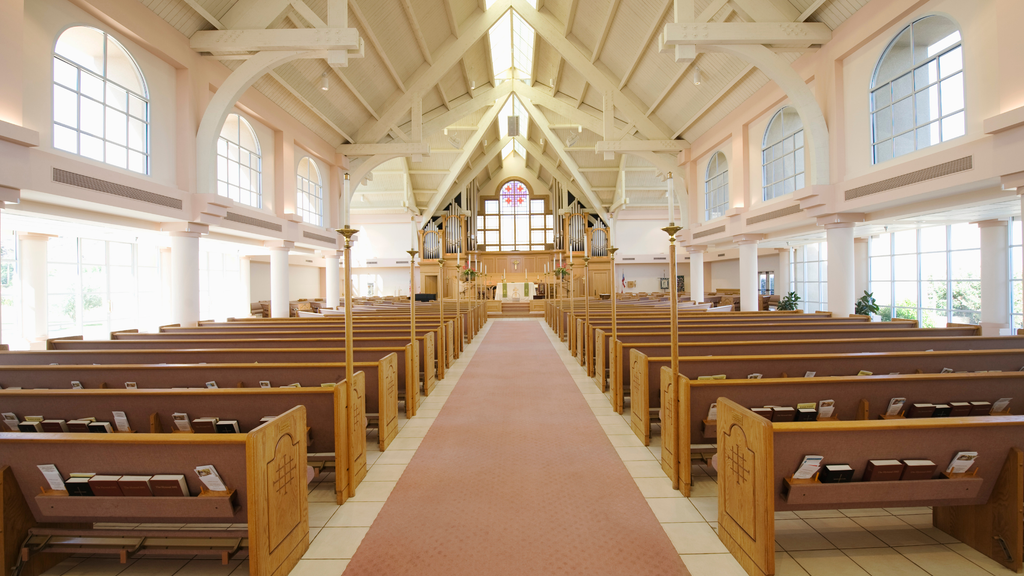
The sanctuary is where the complexity, the budget requirements, and the care requirements converge. Vaulted ceilings require lift equipment rather than ladders and extension poles. Fixed pews, altar furnishings, and sound and lighting equipment require thorough protection before a single drop of paint goes on. The acoustic properties of the space can be affected by the choice of finish on absorptive surfaces. And the colors chosen for the sanctuary carry theological and aesthetic significance to the congregation that a standard commercial paint specification entirely misses.
Ceiling height is the biggest cost driver in sanctuary painting. A fellowship hall with ten-foot ceilings and a sanctuary with thirty-foot vaulted ceilings can be virtually the same square footage in floor area but cost three to four times as much to paint because of the equipment requirements and the time required to work at height. Scissor lifts and boom lifts need to be brought in, positioned, and moved carefully through a space with fixed furnishings on the floor. This is skilled work that takes time.
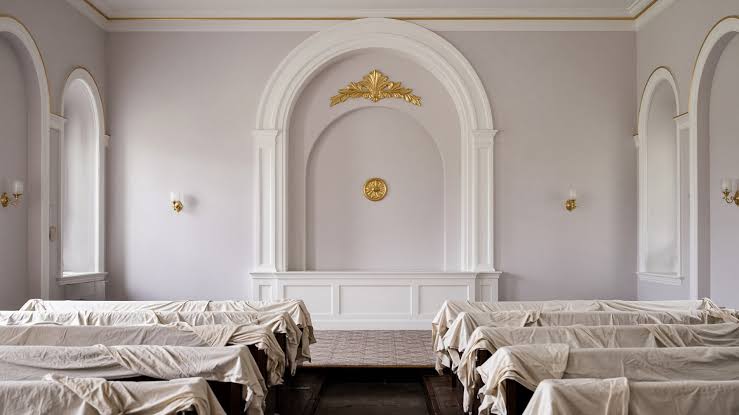
Protection is the other major operational complexity. Before any painting begins in a sanctuary, every pew needs to be covered. Every carpet area. Every fixed lectern, baptismal font, altar table, or chancel furniture piece. Every microphone stand position. Every speaker enclosure. A thorough protection setup in a sanctuary can take a full day before painting even begins, and it needs to be treated as a non-negotiable step. Painting splattered on a century-old stained wood pew or a handmade altar cloth is a real conversation the facilities committee does not want to have with the congregation.
Color selection for sanctuaries deserves consultation with the church leadership rather than a unilateral decision by the facilities committee. The colors in a worship space carry meaning. A traditional liturgical congregation may have specific colors associated with the seasons of the church calendar. A contemporary congregation may want to align with their visual branding. A consultation with the pastor or worship director before finalizing colors avoids conflicts after the project is complete.
Fellowship Halls and Multi-Purpose Spaces
Fellowship halls are the workhorses of church facilities. They host dinners, community events, daycare programs, rentals, youth group meetings, and AA groups. They take more physical abuse than any other space in the building and tend to show it. Scuffs at chair height, grease near the kitchen entrance, crayon marks at child height on the lower walls.
Product selection for fellowship halls should prioritize washability over aesthetics. Eggshell and satin finishes in a washable premium formula handle the cleaning demands of high-use spaces. Lower sheens, including flat and matte, will break down under repeated cleaning in a space as actively used as a church fellowship hall. The finish needs to be one that maintenance volunteers can wipe down with standard cleaning products without lifting the paint film.
Scheduling fellowship hall painting is often the most manageable part of a church painting project because multi-purpose spaces typically have defined dark periods when the room is not scheduled. A four-day weekend project between programmatic uses is often achievable with proper planning.
Children’s Areas and Nurseries: Product Safety First
Children’s ministry spaces require specific product attention. Zero-VOC or low-VOC formulas are non-negotiable in spaces that will be reoccupied by infants and young children within 24 to 48 hours of painting. Standard interior latex, even low-odor products, releases VOC gases during and after application that are inappropriate for enclosed spaces used by children.
Sherwin-Williams Harmony and Emerald Interior are two of the most widely specified zero-emission products for children’s spaces. Both are GREENGUARD Gold certified, which means they have been independently tested and certified to meet strict chemical emission standards for indoor air quality. This certification is increasingly expected by parents and is a meaningful differentiator for churches that want to communicate that they take seriously the environments where children spend time.
Color in children’s areas is where the church often gets creative, and appropriately so. Bright, engaging colors, murals, and themed design elements all have a place in children’s ministry spaces. These elements require a painter who is comfortable with more detailed decorative work, not just standard wall rolling. If the scope includes murals or custom design elements, confirm this specifically with the contractor before the project starts.
Church Exterior Painting: Timing and Material Considerations
Church exteriors in the Tri-Cities face the same UV and freeze-thaw challenges as residential exteriors in this climate. The difference is scale. A church building may have more complex roof lines, more architectural details, multiple substrate types, and larger surface areas that require more planning and more equipment than a standard residential exterior.
Masonry and brick elements on older church buildings require specific products and preparation. Painted brick requires a masonry primer and a breathable masonry paint that allows moisture vapor to move through the wall rather than trapping it behind the paint film. Historic masonry buildings need particular care because the wrong product can cause irreversible damage to historic fabric.
The best time to schedule church exterior painting in the Tri-Cities is spring, specifically April through early June, before the extreme summer heat arrives. This window allows proper paint adhesion and drying conditions. Late summer and early fall, August through September, is the secondary window. The same logic that applies to residential exterior painting in this climate applies to church exteriors.
Budgeting Realistically: What Church Painting Costs in Tri-Cities
Providing an exact budget for a church painting project without seeing the specific facility is not meaningful. But ranges based on typical church spaces in the Tri-Cities provide a useful planning baseline. A standard fellowship hall of 2,000 to 3,000 square feet with 10-foot ceilings: $4,000 to $8,000 depending on surface condition and product specification. A sanctuary with 20-foot or higher ceilings requiring lift access: $8,000 to $22,000 depending on size, ceiling height, and protection complexity. A full exterior on a medium-sized single-building church: $12,000 to $35,000 depending on building size, substrate conditions, and architectural complexity. Classrooms and office areas: $800 to $2,500 per room depending on size and condition.
These numbers are starting points for budget planning purposes. The actual project cost requires a site visit, a surface assessment, and a written scope of work before a reliable figure can be established.
Frequently Asked Questions
1. How do we schedule painting without disrupting Sunday services?
Most church interior painting projects can be completed during weekday blocks when the building is between scheduled programs. For projects that require more time than the weekday schedule allows, a Friday-to-Monday weekend window can accommodate a fellowship hall or large multi-purpose space. Sanctuary painting typically requires more extended access and is best scheduled around vacation periods or during a time when temporary alternative service arrangements can be made.
2. What is the best way to get multiple painting bids for a church project?
Prepare a written description of the spaces to be painted, the approximate square footage of each, the current surface condition, and any special requirements like high ceilings, fixed furnishings, or children’s area product specifications. Provide this to each contractor so you are comparing equivalent scopes rather than different interpretations of the job. Ask each contractor to break down materials and labor separately and to provide a project timeline.
3. Can a church painting project be done by volunteer labor?
Volunteer painting is appropriate for low-visibility, lower-ceiling spaces like storage areas, utility rooms, and some classrooms where the quality standard is maintenance-level rather than finish-quality. Sanctuary painting, exterior work, and any space requiring high-quality finish results is better handled professionally. The equipment requirements for high-ceiling work alone make professional contractors necessary for safety and quality reasons.
4. How do we protect historical items and artwork during painting?
Every item that cannot be removed should be enclosure-protected with drop cloths, plastic sheeting, and appropriate masking before painting begins. Historical items, artwork, stained glass, and any element of irreplaceable value should be identified specifically before the project starts. Walk through the space with the contractor before mobilization and point out every item that requires special handling. Get confirmation in writing that these items will be protected per your instructions.
Working With Volunteers vs Hiring Professional Painters for Church Projects
Many churches attempt to reduce painting costs by using volunteer labor for portions of the project. This is appropriate in some situations and genuinely risky in others. The distinction is important and comes down to the visibility and technical requirements of the space being painted.
Volunteer painting is appropriate for low-visibility, low-complexity spaces where a maintenance-level result is acceptable: storage rooms, utility closets, mechanical spaces, and perhaps some secondary classroom areas. These spaces do not require the preparation quality and finish standard of a sanctuary, lobby, or fellowship hall.
Volunteer painting in high-visibility or high-complexity spaces produces results that reflect the skill level of volunteers, which is typically not the professional standard. Roller marks on a sanctuary wall. Drips on altar woodwork. Uneven finish coverage on a vaulted ceiling that was attempted with extension poles by someone without experience working at height. These results require professional remediation to correct, which often costs more than simply hiring a professional from the start. The honest calculation before committing to volunteer labor should include the realistic assessment of what the result will look like and whether it is acceptable for the space in question.